

A loan applicant deserves a reason that matches the decision record. Before an AI assistant helps with a live credit decision, test whether it can find missing facts, flag contradictions and show a reviewer where each statement came from.
My COVID lending work helped make J$3 billion (Jamaican dollars) available through a large Caribbean commercial bank. I report that the resulting portfolio had a lower default rate than the bank's main portfolio of traditionally banked customers. I have not supplied an independent evaluation, a default definition or the observation period. The differences between the two groups are also missing. Use my account to frame questions for your institution; it cannot set a performance target.
Define what the tool is allowed to do
Write the proposed use in a sentence a credit officer can inspect. An assistant might organise documents for review, identify inconsistent entries or draft an explanation from an approved decision record. Those tasks need different tests from a model that estimates repayment risk. Calling all of them AI can hide which component caused an error.
This applies People First, Problem Second, AI Last to a finance workflow. Identify who needs a decision and what that decision changes. Only then choose the tool and its permitted role. I am proposing how to apply the approach here. The example does not reconstruct the system used in my COVID work.
You cannot know who would have repaid a loan they never received
In Human Decisions and Machine Predictions, Kleinberg and colleagues explain how a decision can determine which outcomes become available for evaluation. They studied US bail decisions. Their study did not examine Caribbean lending. Finance teams should examine the corresponding gap in their own data: applicants who never borrowed have no repayment outcome for that unmade loan. [1]
Do not instruct a language model to fill that gap with its judgement of who would have repaid. The output would depend on assumptions. It would add no observed repayment outcome to the record. Even additional external records may measure a different product or period. The person responsible for validating the model should determine what comparison those records can support before they enter a performance claim.
Keep the original application decision, any later review and the eventual outcome in separate fields. That makes it possible to ask whether the recommendation was wrong, the record was incomplete or the offer changed. If your dataset collapses those events into a single status, improve the record before trying to interpret a headline accuracy measure.
Check what a lower default rate is comparing
Ask the evaluation team to define default before comparing portfolios. It should state whether the rate counts borrowers, loans or balances, how restructurings are treated and how long each group has been observed. Recently issued loans and older loans have had different amounts of time in which a borrower could default. A lower rate alone cannot establish that the underlying assessment was better.
Also inspect who entered each group and which terms they received. The model may influence a lending decision, as may the credit policy, repayment schedule or relationship manager. Keep these changes visible so that a result attributed to the model does not silently include a different product or a different mix of customers.
The US agencies’ revised guidance of 17 April 2026 provides a reference for testing and validating quantitative credit models. It expressly excludes generative and agentic AI. The document exercise below calls for separate controls under your institution’s policies and applicable rules. [2]
Show the credit officer which records disagree
Imagine an assistant finding different income figures in two authorised documents. It should identify the discrepancy and point to each source. It should not choose the larger figure because doing so produces an affordable-looking payment. The relationship manager needs a defined route for checking the record and documenting the correction.
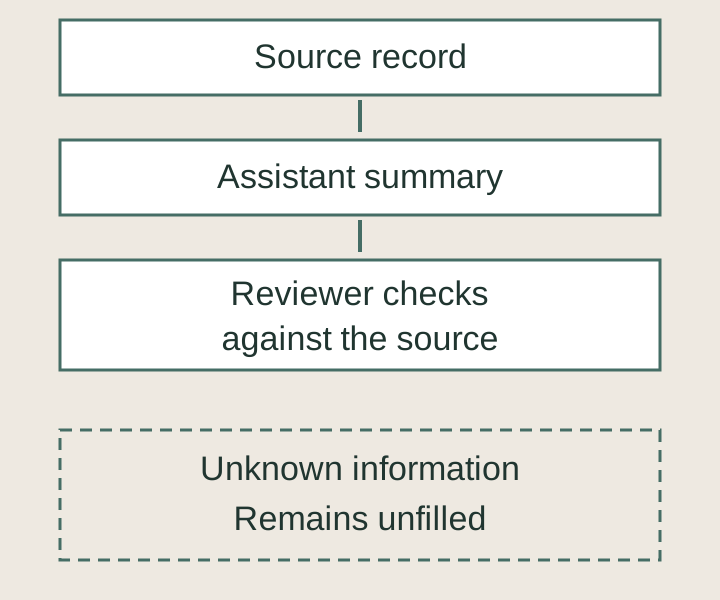
Static explanation shown. Select Play to follow the diagram.
An AI-drafted explanation should use the decision actually made. Ask the reviewer to trace each stated reason to the approved record. If the assistant invents a reason that sounds plausible, stop use of that output and investigate the failure. A polished explanation can make an incorrect decision harder for the customer to question.
The final record should say why the decision was made. A missing document needs a different response from a policy restriction or a risk assessment. A customer may be able to correct a document; a policy exception may require a different decision-maker. Keep an accountable person responsible for communicating the next step.
Test the assistant on historical records
With the risk owner’s approval, choose a small set of authorised, de-identified historical cases that includes incomplete and contradictory records. Keep the exercise separate from customer decisions and use an approved environment for the information.
Have a credit officer establish the reference record first. Ask the assistant to extract the facts, identify unknowns and cite the supplied source for each statement. Record unsupported statements, missed contradictions and the review time needed to obtain an acceptable output. Count cases that cannot be completed instead of dropping them from the result.
Use this small exercise to decide whether to stop, narrow the task or design a larger evaluation. Assess predictions of non-payment and the rules for refusing applications separately from this document-checking exercise. If the exercise finds that reviewers repeatedly have to reconstruct the source record, fix that workflow before assigning the assistant another task.
Protect the customer when the system is wrong
Affordability and customer understanding remain necessary even when the tool recommends approval. A customer can be harmed by unsuitable lending as well as by an incorrect refusal. Ask who can challenge the recommendation, correct an input and escalate an unresolved case. Give those people access to the evidence they need, with appropriate restrictions on personal information.
Record when a reviewer changes the AI recommendation and why. A reviewer who repeatedly corrects the same failure is providing evidence about the system's limits. The response may be to change the source, restrict the tool or stop using it for that task. Expanding deployment while relying on unrecorded human repairs would conceal the cost and the customer risk.
The bank remains anonymous. In separate Caribbean fintech work, I reported a default rate below 2% and a customer base around 90% unbanked.
Sources & further reading
[1] Kleinberg et al., Human Decisions and Machine Predictions (working paper, p. 8) ↗[2] Federal Reserve, OCC and FDIC, revised model risk guidance (scope and exclusions) ↗Federal Reserve supervisory letter SR 26-2 ↗Sources checked 2026-11-06.