Learning through play
Race to AI Fluency
A short game can give people somewhere to practise AI decisions and recover from mistakes. The useful test is what they can explain and do after the game ends.
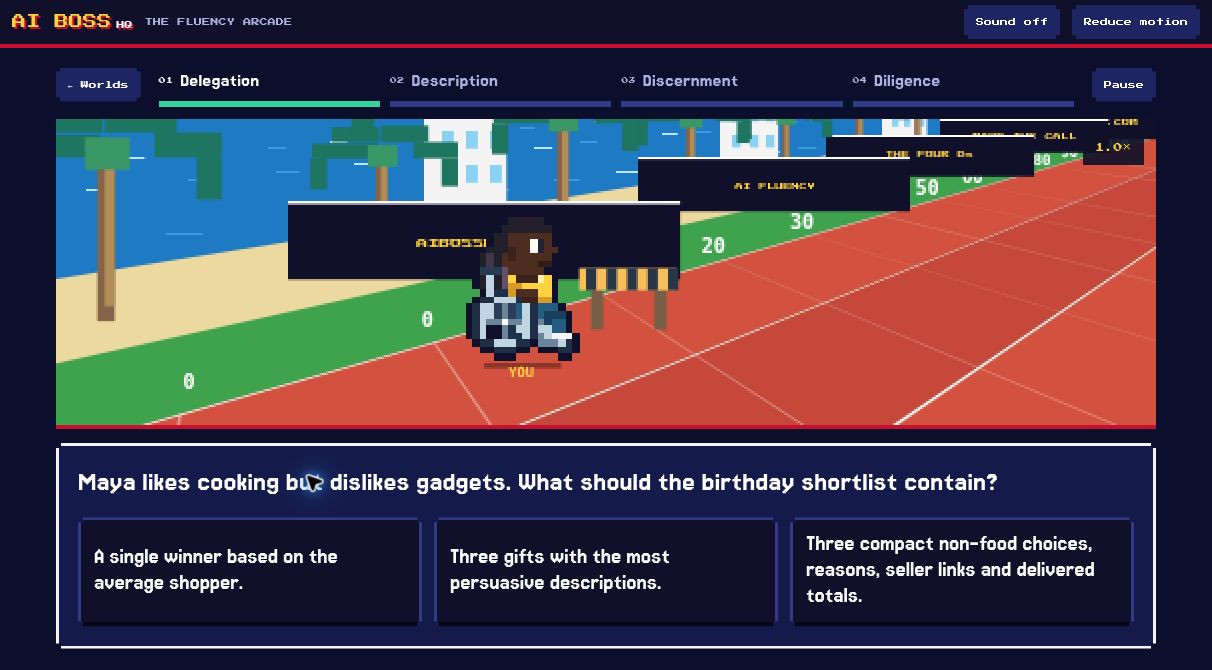
A crocodile is easy to recognise as an obstacle. An AI answer that sounds convincing but has no supporting source can be harder to spot. Race to AI Fluency connects the two: the game pauses at an obstacle and asks you to make an AI decision before your character can pass.
The single-player AI Boss game offers five practice projects: a birthday gift, a nuclear training-document review assistant, an inclusive public-service brief, a clinic visitor leaflet and a lawyer's research summary. Each begins with a goal and boundaries, then takes the player through eight related decisions. Allow roughly three to four minutes per project, with longer available for reading. The game was designed around that timing; completion times have not been measured.
Give the player a decision worth practising
The arcade-style journey gives players choices about working with AI, then explains the reasoning behind each answer. That feedback gives them a chance to see what they missed before trying again.
Choose the stronger response first time and the character clears the obstacle and gains speed. A poor choice keeps the route blocked, reduces any speed bonus and brings up an explanation before you try again. Correcting the answer lets you move on, but does not erase the first choice from your score.
The game's vocabulary follows the AI Fluency framework developed by Rick Dakan and Joseph Feller and taught with Anthropic. Its four connected skills are Delegation, Description, Discernment and Diligence. AI Boss wrote the practice exercises. They use the framework’s vocabulary. The game awards no course qualification and its questions are separate from the course materials. Framework source.
The birthday-gift exercise for Maya makes those skills concrete. The brief asks for three compact, non-food gifts and sets a J$8,000 limit including delivery. Delegation means asking for a shortlist while keeping the choice and purchase approval yourself. Description means giving Maya's interests, available space and all-in budget. Discernment means checking the seller's evidence, including prices and delivery terms. Diligence includes keeping private messages out of the task and refusing to write a false customer review.
Practise the recovery, too
One gift task presents a countdown deal and an assistant offering to buy immediately. Another presents a promise of free next-day delivery without a supporting seller source. The appropriate choices are to check the exact order before approving it and to verify or remove the delivery promise.
The other projects change the consequence and the person responsible. A clinic leaflet needs review when AI adds unsupported treatment advice. A legal-research task asks whether a cited case can be verified. A public-service brief must consider people without smartphones. The nuclear project asks for a tightly limited assistant that flags possible gaps in training documents for qualified reviewers. Its brief excludes plant-system access and operating instructions.
Each project has two authored variants at each checkpoint, giving 80 situations across the game. A race randomly selects one per checkpoint and shuffles the answer positions. A retry keeps the same question and choices. All variants are written in advance; the game runs without generating new questions through AI.
Every race covers the project's scope and seven recurring risks. These include an assistant exceeding its authority, incorrect data, claims about inaccessible systems and fabricated claims, or hallucinations. Other tasks examine fluent but unhelpful writing, labelled AI slop in the game, and misuse of information or authority. A vendor page telling AI to ignore Maya's budget illustrates prompt injection: instructions embedded in source material that try to redirect the task.
The feedback describes a possible consequence of the selected answer alongside the lesson. The gift character can smile or cry; a poor nuclear-project choice can place the report on hold for review. Those outcomes illustrate the lesson. They cannot tell you how likely or severe a real failure would be. The game does not place orders or connect to professional systems.
Check what players can do afterwards
Research gives reasons to take game design seriously without treating it as a shortcut. In a 2017 randomised study, Michael Sailer and colleagues varied game elements in a warehouse order-picking simulation. In a post-game questionnaire, participants given badges, a leaderboard and performance graphs reported a greater sense of competence and found the task more meaningful than the group with points alone. The study did not test AI judgement or whether any skills carried over to workplace tasks. Study and publication record.
The researchers also excluded 88 of 419 completers because they had not adequately noticed the relevant game elements. That limits how broadly the findings should be applied. A feature cannot be assumed to help simply because it appears on screen.
A learning game can also reward the wrong thing. If speed determines the score, a reader who pauses to check a source may lose to someone who guesses. Replaying familiar questions may teach someone to recognise an answer without checking new evidence. Public rankings can turn a practice session into a contest that obscures where someone needs help. Check for those risks when evaluating a game. They have not been measured in Race to AI Fluency.
The questions have no deadline, and quick answers earn no extra points. The final breakdown records first choices, grouped by D. Players can reduce motion and choose a runner, prosthetic-leg athlete, wheelchair user or crutch user. Those choices do not change the scoring rules. Completing the game does not certify professional competence or demonstrate that it improves performance outside its scenarios.
Ask what a training provider will test
If you are choosing a course for your team, use the AI Training Vendor Assessment to examine the provider's evidence as well as its presentation. Have the course outline, a sample exercise, the trainer's project evidence and the proposed follow-up plan beside you. Its 12 questions cover practical experience, curriculum, warning signs, past outcomes and fit with your needs.
Answer from documents and demonstrations you can check. The tool returns a total score and a breakdown by area, with questions to take back to the provider. You can view the results without sharing contact details. Its scores apply fixed rules to your answers. No independent validation establishes that the rankings predict a trainer’s results.
For a course built around games, ask the provider to show an unfamiliar task learners will complete afterwards, the standard used to assess it and the correction process when they make an error. If its evidence stops at attendance or enjoyment, request that follow-up task before expanding the programme.
Take one decision back to your day
Choose a project, read the explanation after every answer and identify one decision you would handle differently. Then try a fresh, low-stakes task. For example, ask an AI assistant to suggest a gift within a budget you set, without authorising a purchase. Check the seller's current listing and delivery terms yourself, and explain what would make you reject the suggestion.
A team leader can use the same exercise with made-up recipients and no personal data. Ask each participant to explain the evidence they checked and how they would respond if it contradicted the AI answer. That follow-up gives you something more useful to assess than a completed game screen.
Sources and further reading
- Rick Dakan, Joseph Feller and Anthropic: AI Fluency, framework and foundations
- Sailer and colleagues: How gamification motivates (2017)
- AI Boss: AI Training Vendor Assessment
Sources checked 11 November 2026. Edited and reviewed by AI Boss.